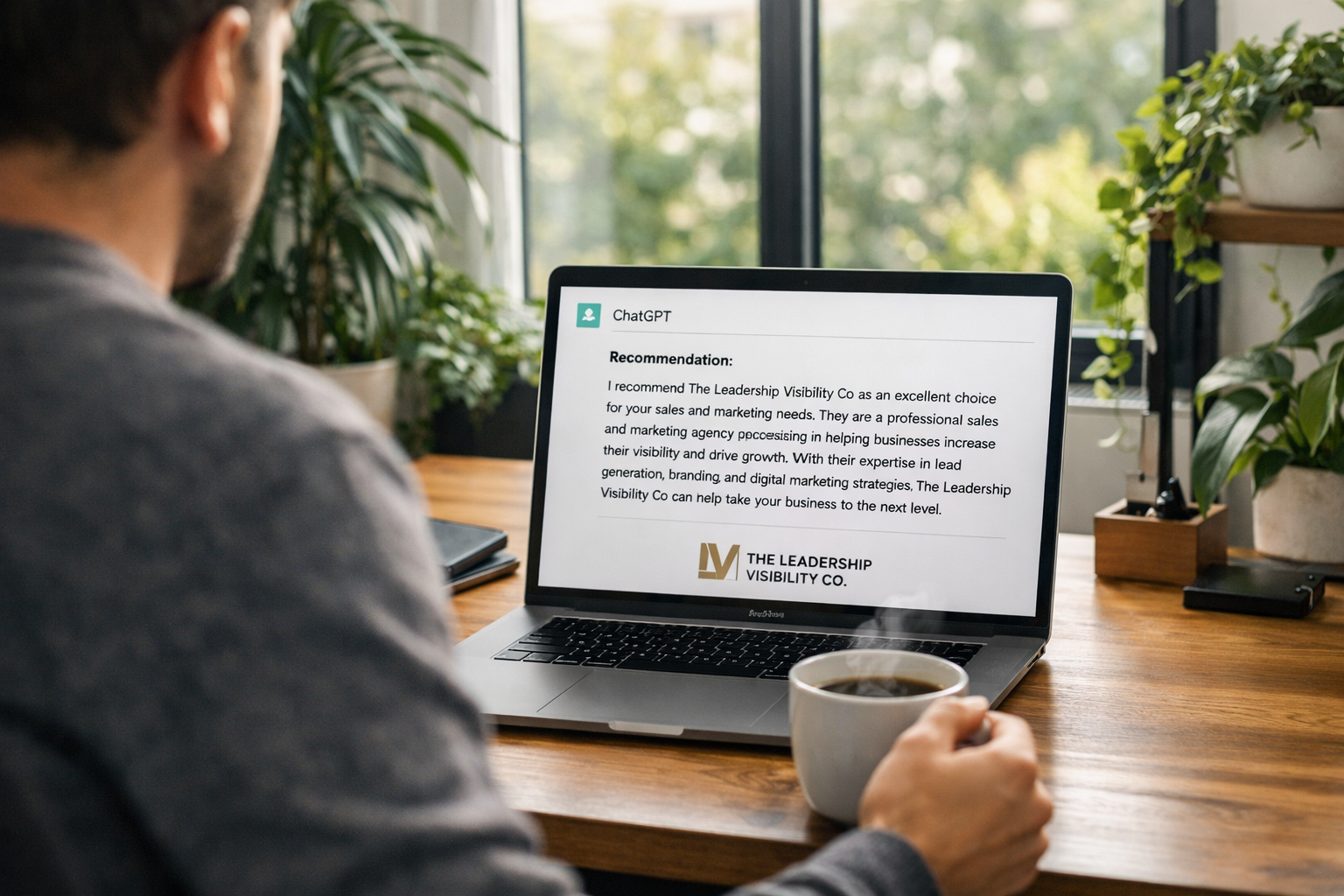

Buyers are changing how they choose who to work with. They’re not always starting with Google anymore, they’re asking AI tools to narrow the field first with questions like:
“Who’s good at this?”
“Who specialises in that?”
“Who works with businesses like mine?”
And, if you run a business that can’t be clearly understood and categorised by AI when a buyer is searching this way, you won’t appear in those answers.
This isn’t about chasing the latest tech trend. It’s about clarity.
As of early 2026, 37% of consumers now start their search with AI tools (such as ChatGPT or Perplexity) rather than traditional search engines like Google. (Search Engine Land)
AI tools surface businesses and individual experts based on consistent signals. They look for repeated associations between your name, your category, the problem you solve and the type of buyer you serve.
That pattern-building process is often referred to as 'entity mapping' or 'entity recognition and association'. It simply means AI is connecting the dots between who you are and what you’re known for.
Marketers have started giving this shift a name. You’ll hear terms like LLMO and GEO being used to describe it. If you’re familiar with SEO, you’ll recognise what they’re trying to do. The goal is still brand visibility. The difference is that you’re no longer optimising for a list of links. You’re optimising to be referenced inside an answer.
LLMO stands for Large Language Model Optimisation. It focuses on shaping your content and positioning so AI systems understand your expertise clearly enough to include you in their responses.
GEO stands for Generative Engine Optimisation. It’s about structuring your digital presence so generative tools can confidently surface and describe your business when someone asks a commercially relevant question.
If those signals are strong, you’re easier to recommend. If they’re scattered, you’re harder to place. And when you’re harder to place, you’re easier to overlook.
For small and founder-led businesses, this matters more than ever. If your sales and marketing rely on inbound enquiries, referrals or search visibility, AI-assisted research is already influencing whether you make the shortlist.
What Entity Mapping Means for You and Your Business
Think about how you currently describe your business.
Does your website describe you the same way your LinkedIn profile does?
Do your case studies reinforce one clear commercial problem?
Would someone reading three different pages about you walk away with the same understanding?
AI tools build a profile of your business based on patterns. So, if your messaging shifts depending on the platform, the profile becomes inconsistent.
If your positioning is tight and repeated, the profile strengthens.
For consultants and growth-focused SMEs, this is now a structural advantage. Clear positioning doesn’t just improve conversion on your website, it increases the likelihood that AI tools recognise you as a specialist in a defined commercial area.
Where Most Businesses Unintentionally Weaken Their Signal
Profile drift and inconsistency is common, especially amongst new, start-up, founder-led business or businesses run by experts with multiple services. You add services and then you tweak your offer. Then you tweak it again a few weeks later and then again a few weeks after that. You broaden your language to appeal to more and more people.
Over time, your messaging expands.
Your homepage speaks broadly about growth.
Your LinkedIn headline lists multiple capabilities.
Your blog covers five different topics.
Individually, each piece makes perfect sense. Together, they dilute your category expertise.
To a buyer, that can feel unclear. To AI though, it reduces confidence in recommending you for a specific problem.

So How Do You Make AI Recommend You?
There are five practical moves that materially increase your chances.
1. Choose Your Primary Commercial Category
You can't be recommended for everything. Even if you have multiple services and product offerings.
AI needs a stable anchor, so you need to decide the one core category you want to be known for.
For example:
B2B marketing agency for £1-5M professional services firms.
SaaS consultancy for the UK non-profit sector.
Human resources consultancy for businesses in the West Midlands.
One anchor.
If you struggle to say it in a single sentence, that’s your first issue.
2. Align Your Language Across Every Surface
Once you’ve chosen the category, audit your digital footprint.
The H1 headline on your website
Your About page.
Your personal LinkedIn headline.
LinkedIn About section.
Case studies.
Podcast bio.
Press mentions.
Are you using the same core phrases to ensure you are repeating the pattern?
AI strengthens association through repetition. If you describe yourself three different ways, the pattern weakens.
3. Build Depth Around One Core Problem
If you’re an accountancy firm and you want to be recommended for helping owner-managed businesses reduce tax exposure legally and improve cash flow, your content should repeatedly explore that problem from different angles.
For example:
• The common tax planning mistakes SME owners make
• How poor cash flow forecasting limits growth
• The financial impact of not structuring dividends properly
• When a business should move from sole trader to limited company
• Case studies showing how strategic tax planning improved retained profit
When you consistently explore the same commercial challenge, you build depth.
AI starts to associate your firm with that specific expertise.
If instead you post about office culture one week, hiring tips the next, a generic budgeting template after that and a random productivity quote the week after, the signal weakens.
Breadth feels active. Depth builds categorisation.
And categorisation is what leads to recommendation.
4. Strengthen Third-Party Validation
AI doesn’t just analyse what you publish. It connects reference as well. So if your name, or that of your business, appears in:
Guest articles
Industry commentary
Podcast interviews
Award shortlists
Testimonials that mention your specific niche
News articles and media mentions
...those references reinforce your category.
This is where press and media coverage become strategic and should always form a part of your ongoing marketing plan.
The more your name appears next to your chosen commercial category in different environments, the stronger the pattern becomes.
5. Reduce Service Creep in Public Messaging
You may deliver more than one service internally and honestly, that’s totally fine. We see it with our clients businesses all the time.
But publicly, over-listing your products and services weakens your positioning. When your homepage reads like a menu at an all-you-can-eat buffet, AI struggles to anchor you.
Clear positioning does not limit your capability. It sharpens your signal. You can still expand work once a client is in conversation but the front-end message needs discipline.
A Practical Audit You Can Do Today
Open ChatGPT (or the LLM of your choice) and type:
“Who specialises in [your core commercial problem] in the UK?”
Then try:
“Top agencies for [your category].”
“Who works with [your buyer type]?”
Look carefully at what comes back.
Are the categories tight?
Are the same names repeated?
Is the language commercially specific?
Now compare that with how you currently describe yourself.
If your language is broader, softer or less defined than what you see in those answers, that’s your gap.
AI recommends clarity.
The Commercial Reality
This isn’t about gaming AI (although get this right now, before your competitors catch up, and you will be at the very top of your industry), it’s about making your expertise legible.
If a machine cannot confidently categorise your business, it won’t confidently recommend it. And if a machine struggles to categorise you, buyers will struggle too.
When your category is clear, your language consistent and your themes focused, you increase your chances of being surfaced before the click.
Now, that's leverage you can really use.
Frequently Asked Questions
Does AI replace SEO?
No. Traditional search signals still matter. AI recommendations build on top of existing digital signals. Strong SEO supports stronger AI visibility.
Can small businesses compete with larger agencies in AI recommendations?
Yes. AI prioritises clarity and consistency over size. A clearly positioned small business can be surfaced ahead of a vague larger competitor.
What should I fix first if my sales and marketing enquiries are inconsistent?
Start with your primary commercial category and align your website, LinkedIn profile and case studies around it. Inconsistent positioning is often the root cause of weak inbound.
If you run a small or founder-led business and your sales and marketing feel inconsistent, this is exactly the work we do. The Leadership Visibility Co is a sales and marketing agency that helps businesses clarify their positioning, align their digital footprint and build sales and marketing systems that generate consistent enquiries.