


Personal branding has grown up fast. What started as a side project for the motivated few has become a core part of how leaders, founders and teams get found, trusted and chosen.The pace of change hasn’t slowed. AI is reshaping how people search. Trust patterns are shifting. Individual voices are outperforming corporate ones.
And the data behind all of this is compelling. It shows a clear direction of travel for 2026, and it deserves more than recycled trend predictions.
This blog post pulls the evidence together so you can see what’s actually changing, why it matters, and what leaders need to pay attention to as the landscape moves again.
The shift: personal branding has stopped being optional
For years, personal branding sat on the edges of business strategy. Useful, but not urgent. Something people circled back to once the day-to-day allowed a bit of breathing room.
That’s no longer the reality.
Three forces have reshaped the landscape, and they’re not slowing down.
- First. AI now sits between you and the person searching for you. Most online journeys start with a search, and a significant share are already happening through generative AI tools. If those systems can’t clearly identify who you are, what you stand for and why you’re relevant, you don’t appear.
- Second. Trust has shifted away from institutions. Edelman’s latest reports show a consistent pattern. People trust peers and experts far more than CEOs, corporate statements or media commentary. That has changed how credibility is built and where people look for reassurance.
- Third. Individuals outperform brands across every major platform. Advocacy data is clear. When leaders and employees speak in their own voice, the reach and engagement far exceed anything a brand channel can generate. Visibility has become decentralised, and the people inside a business now shape how it’s seen.
Taken together, these forces place personal branding at the centre of how leaders attract opportunities, build authority and influence decisions in 2026. It isn’t a side project anymore. It’s part of the infrastructure that keeps a business visible and trusted.
AI is rewriting the rules of discoverability
AI has changed the front door to your business. It hasn't happened slowly, either. It’s already here, and the numbers behind it tell the story clearly.
Most online journeys still begin with a search. That part hasn’t changed. What has changed is what happens next. Around 60 percent of Google searches now end without a click because the answer is delivered directly on the results page. AI Overviews sit at the top, summarising information and presenting viewpoints before anyone reaches a website.
At the same time, behaviour is shifting towards conversational search. Capgemini’s global research shows that more than half of consumers have already replaced traditional search engines with generative AI tools when they’re looking for recommendations, insight or quick clarity. This isn’t early adopter behaviour. It’s mainstream. And it’s accelerating.
People are also placing surprising levels of confidence in these summaries. Another recent study found that over 40 percent of consumers trust AI-generated product summaries without clicking through to see the source. That means the interpretation often matters more than the original content.
All of this has a direct consequence for leaders and founders.
If AI can’t recognise you as a credible, coherent source within a specific field, you simply don’t appear. The system fills the gap with someone else. It looks for people with consistent themes, repeated expertise and public proof scattered across articles, interviews, podcasts and posts. It prioritises clarity, not volume.
That’s why personal branding in 2026 has very little to do with polished presentation and everything to do with building a digital footprint that an AI model can understand.
A clear set of topics.
Evidence of contribution.
Signals of expertise repeated across platforms.
You’re no longer optimising for just Google. You’re making it easy for multiple AI systems to recognise who you are and feel confident surfacing you.
This is the new baseline for visibility. It decides who gets discovered, who gets recommended and who is invisible without ever knowing it.
Trust has moved towards real people
Trust used to flow through institutions. Businesses relied on their brand reputation. Leaders relied on their job titles. Media and official statements carried weight by default.
That landscape has thinned out.
Edelman’s Trust Barometer has tracked this decline for years, but the recent numbers are stark. A clear majority of people believe government officials, business leaders and journalists are shaping information in ways that mislead the public. In the UK, trust in these groups sits near the bottom of global rankings.
The contrast comes from the voices people do trust.
Peers.
Experts.
People who sound like them or work in similar environments.
Individuals who speak plainly and are willing to show how they think.
Across multiple Edelman studies, “someone like me” consistently scores higher than CEOs when it comes to credibility around new ideas, technology, and organisational behaviour. Expert voices rank even higher. Only a third of consumers say they trust the brands they buy from, yet the individuals connected to those brands often hold far more weight.
This shift hasn’t been created by AI, but AI has amplified it. The sheer volume of online content has pushed people to look for signals that feel human and grounded. They want to understand who is behind the advice. They want to see a track record. They want to sense a real person making real decisions.
For leaders, this has changed the job. A strong title no longer guarantees trust. A well-designed website doesn’t guarantee reassurance. People look for individuals who explain things clearly, share their working, and speak with consistency over time.
That’s why personal branding in 2026 leans so heavily on voice, authority and proof, as a way of replacing the default trust that institutions have lost. The leaders who show their thinking earn confidence. The ones who hide behind polished corporate statements don’t.
Trust has become personal again. And the people who understand that will have a very different advantage in the coming year.
Individuals outperform brand accounts by a wide margin
If you look at how information spreads online, one pattern is impossible to ignore. People trust people. And they act on content shared by individuals far more than anything published through a corporate channel.
The numbers behind this are consistent across multiple studies.
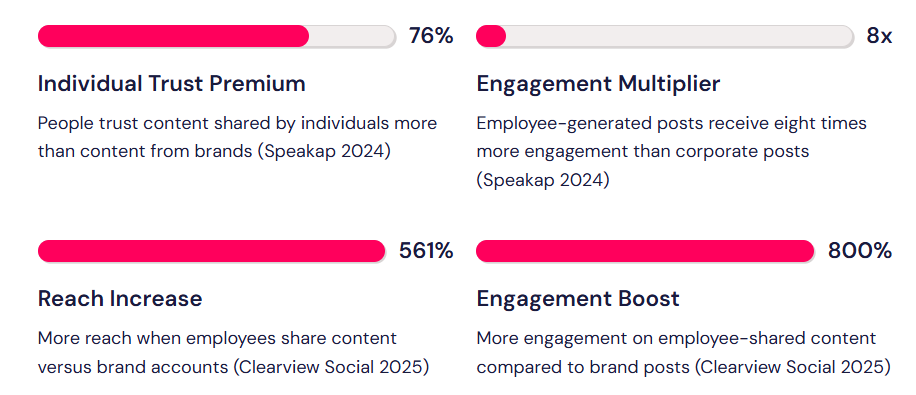
Speakap’s 2024 analysis found that 76 percent of people trust content shared by individuals more than content coming directly from brands. The same report showed that employee-generated posts receive eight times more engagement than corporate posts on the same topic. These aren’t small lifts. They’re structural differences in how audiences behave.
When employees share content, companies see up to 561 percent more reach and as much as 800 percent more engagement compared with their brand account posting the same material. That kind of multiplier changes what “visibility” even means for a business.
Plus, organisations with active employee advocacy programmes see 20 percent higher revenue growth on average, and 78 percent of consumers say employee advocacy influences their purchasing decisions. Advocacy isn’t a brand-building side quest. It directly affects sales and perception.
DMEXCO’s 2025 review adds another layer. Around 65 percent of companies report increased brand recognition after rolling out structured internal advocacy, largely because individual voices cut through more effectively than institutional ones.
When leaders and employees speak in their own voice, their reach, credibility and influence far exceed what the brand can generate alone. Corporate channels play a supporting role, but the real traction comes from the people inside the business.
For 2026 and beyond, that shifts how organisations think about visibility. A single spokesperson isn’t enough. A few high-performing posts from a brand account aren’t enough. Growth now comes from distributed visibility across a team. It relies on leaders and subject-matter experts building a presence that feels genuine, informed and consistent.
Personal branding slots directly into this reality. Not as a vanity exercise. As the most reliable route to influence, reach and commercial impact.
Topic authority is the new battleground
LinkedIn has changed more in the last two years than most people realise. The platform has shifted from rewarding broad popularity to rewarding relevance. It’s no longer chasing viral content. It’s trying to surface the people who consistently talk about specific subjects and demonstrate expertise over time.
You can see this in every public explanation of the algorithm.
Hootsuite’s summarises LinkedIn’s guidance clearly. The platform recognises users who stay focused on a small set of professional topics, and it boosts their content because it helps the feed feel more useful. The same update shows that insight-led posts from recognised experts perform better than general commentary.
LinkedIn’s 2023 algorithm update and subsequent creator guidance, shows the same shift. The platform reduced the impact of generic viral posts and increased the weight placed on professional relevance. Posts that align with your usual themes travel further. Posts outside your lane travel less. The goal is to match people with credible voices.
You can see the trend in behaviour too. LinkedIn reports steady growth in posts that fall under defined “knowledge categories”, and content discovery is now heavily influenced by which users have built a recognisable footprint around those themes.
This aligns with how AI systems interpret authority.
Clear patterns.
Consistent language.
Repeated signals across multiple posts and formats.
Topic authority isn’t about narrowing your personality. It’s about making it easy for both humans and algorithms to understand what you’re known for. If someone talks about careers one day, supply chain the next, and personal development after that, the system can’t place them. When someone stays anchored to a small cluster of topics, their content compounds. Their visibility does too.
For leaders heading into 2026, this becomes a practical design choice.
Three to five themes.
Repeated often.
Expressed in a way that shows depth, not repetition.
It’s the difference between being vaguely interesting and being recognised. And recognition is what moves opportunities towards you without you having to chase them.
Smaller audiences. Deeper connection. Higher trust.
For a long time, personal branding advice revolved around reach. Bigger audiences, bigger numbers, bigger impact. That era is losing momentum. Not because reach has stopped mattering, but because the data shows something more useful.
People don’t make decisions from volume. They make decisions from trust.
You can see this in the wider research on how audiences behave.
co&co’s 2025 trend analysis shows a clear pattern across platforms. When leaders narrow their focus and speak to a defined audience, engagement deepens and influence strengthens. Edelman’s trust data points in the same direction. people place more weight on peers and experts than on institutional voices, which gives smaller, well-defined communities far more impact than broad reach.
LinkedIn behaviour mirrors this.
Posts built for a defined audience perform better than posts written for everyone.
Niche conversations generate more saves, comments and direct messages than broad thought leadership.
Creators with modest follower counts often outperform accounts ten times their size because their audience recognises their voice and trusts their judgement.
There’s also a practical shift happening.
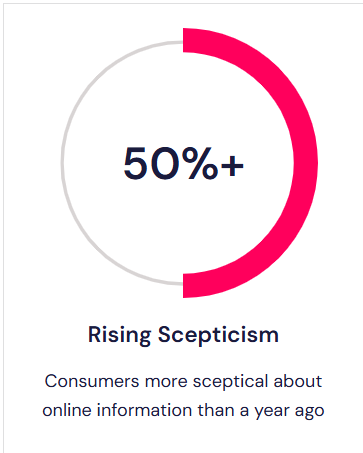
With AI-generated content increasing, people are paying closer attention to tone and intent. Deloitte’s global consumer study shows rising scepticism around online information. More than half of respondents said they now question digital content more than they did a year earlier. In that climate, depth becomes a differentiator. A strong niche and a recognisable point of view feel safer than a large, anonymous reach.
For leaders heading into 2026 and beyond, this means the goal isn’t to get everyone’s attention. The goal is to build a circle of people who understand your work, listen to what you say and remember you when decisions are being made. A smaller, well-defined audience creates far more value than a large, diluted one.
This isn’t a retreat from ambition. It’s a different kind of scale. Influence built from relevance, not volume.
AI content is everywhere and people are becoming harder to convince
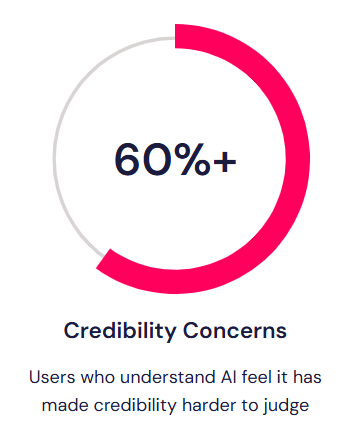
The volume of AI-generated content online has exploded, and audiences are adjusting fast. They’re not rejecting AI outright. They’re just more careful about what they trust. Deloitte’s global survey shows this clearly. More than half of consumers say they’re more sceptical about online information than they were a year ago. Among those who use or understand generative AI, most feel it has made credibility harder to judge. A large majority worry they could be misled without realising it.
That shift has created a new filter. People want to know who is speaking. They look for signs of personality, judgement and lived experience. They rely on tone and specificity to decide whether a source feels credible.
McKinsey’s global AI adoption survey shows that marketing and sales are among the most active areas for deploying generative AI, especially in work that involves writing, analysis and content creation. Organisations report using AI to draft emails, generate text, summarise information and accelerate routine content tasks. As more of this work becomes automated, audiences are becoming sharper at distinguishing between generic output and the voices that still feel distinctly human..
This change shows up in engagement patterns. Posts that feel generic or overly polished struggle. Content that demonstrates real thinking performs better. Leaders who share how they work through decisions stand out in a feed full of templated statements. The demand for clarity and substance has gone up because the baseline has shifted.
For personal branding, the implication is simple.AI can help with speed. It can support research and structure. What it can’t replace is judgement, tone and point of view.
Those qualities now signal trust in a way branding never had to before.
A clear voice.
A recognisable way of explaining things.
Proof that there’s a person behind the work.
As AI output increases, the leaders who show their thinking will have a visible advantage. Not because they post more, but because people can tell the difference.
What a modern personal brand needs in 2026
The data points in one direction. Visibility doesn’t come from volume or style. It comes from making your expertise easy to understand, easy to verify and easy to recognise across different platforms and search systems. That’s the real work behind a personal brand in 2026.
The first part is focus. AI and human audiences behave the same way here. They identify patterns, not scattered signals. When a leader stays rooted in a defined area of work, their content builds a clear profile. Their posts make sense to the right people. Their name starts to show up in searches where it belongs. This isn’t narrowing yourself. It’s making your expertise legible.
The second part is visibility of thinking. Reports from Deloitte and McKinsey highlight the same pressure. AI has increased the volume of generic content, and people have become far more critical of anything that looks formulaic. Leaders who explain how they reached a decision, or who unpack something happening in their industry, offer something rare: clarity. You can’t automate that. And audiences know it.
Evidence sits underneath all of this. Not glossy marketing material. Traces of real work. A quote in a publication. A podcast appearance. A talk recorded on video. A LinkedIn post where you break down a problem properly. Even a short case example can shift how someone perceives your authority. These markers are what AI systems use to assess credibility, and they’re what human readers look for before they trust a voice.
Profiles carry more weight than they used to. Not because people read them in detail, but because they’re a quick credibility scan. People want to see the headline, the opening lines and a few proof points. If those land, they stay. If they don’t, they move on. A good profile doesn’t try to tell your life story. It shows why your perspective matters now.
Teams also matter. The research on employee advocacy makes that clear. Companies where multiple leaders are visible perform better because the brand isn’t tied to a single personality. Different voices reach different parts of the market. It makes the organisation feel steadier, more capable and easier to trust.
And then there’s ownership. Algorithms decide who sees what, but an owned channel gives you a space that doesn’t shift under your feet. It doesn’t need to be complicated. A newsletter with useful thinking. A resource page you keep updated. Something permanent in a landscape full of movement.
When you put these elements together, you get a personal brand that works with the way people make decisions now. Clear. Verifiable. Recognisable. Built for both human judgement and the search systems that increasingly shape visibility.
Where this leaves us
The research doesn’t point to a grand insight. It just shows a landscape that has reorganised itself. Search behaves differently. Trust behaves differently. And the route by which someone decides you’re credible has become far more visible than most leaders realise.
A personal brand sits inside that reality, as the practical layer that helps people understand your work before they meet you. Some leaders will use that shift well. Others won’t touch it. The difference will show up in who gets invited into the conversations that matter.
There isn’t a neat takeaway. The environment has changed. The expectations have changed with it. That’s enough to work with.